

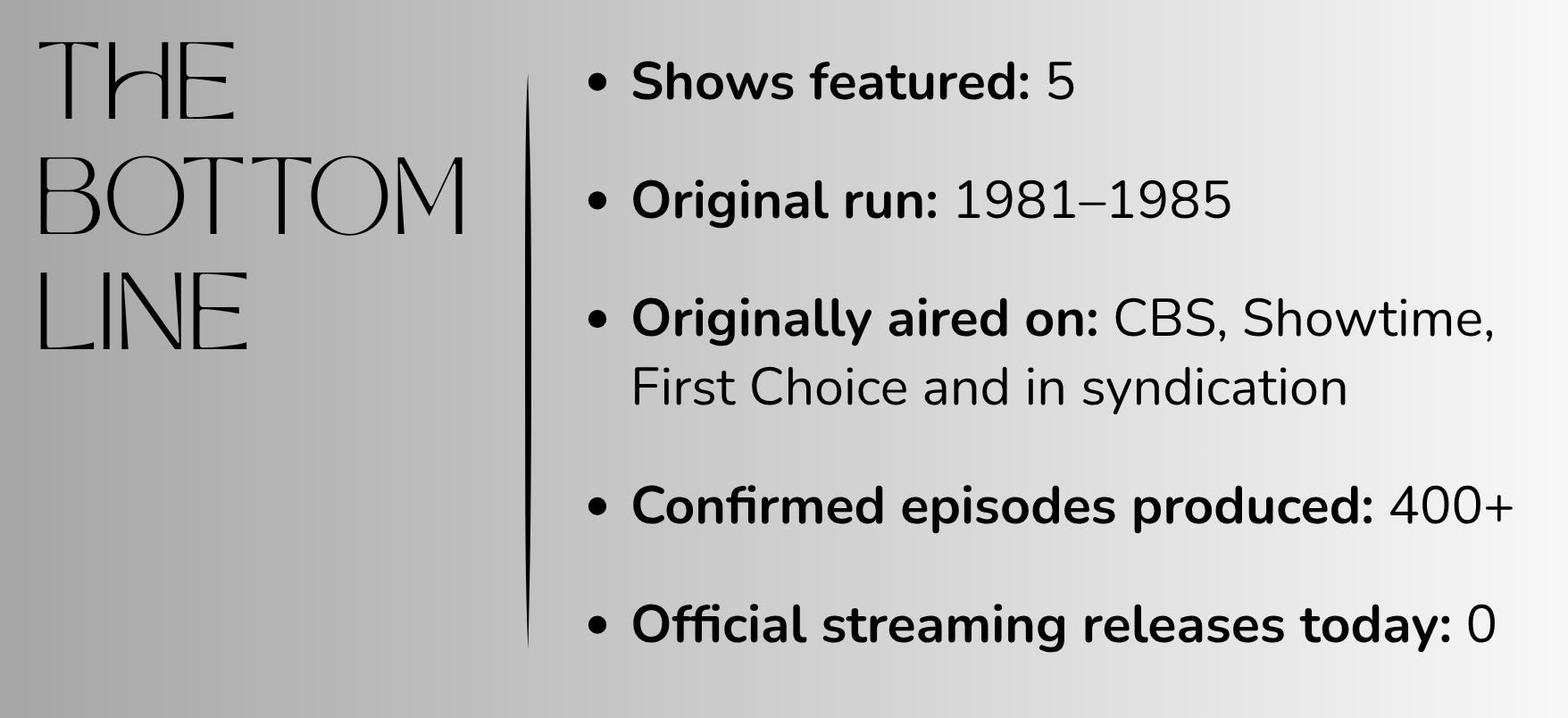
From CBS late-night experiments to Showtime originals and ambitious syndicated dramas, these forgotten serials pushed the boundaries of television—and then seemingly vanished.
For every Dallas, Dynasty, and General Hospital, there were ambitious soap operas that disappeared almost as quickly as they arrived. Some pushed creative boundaries. Others experimented with new formats, while a few were simply ahead of their time. Today, most survive only in promotional clips, scattered recordings, or fading memories. After hearing actor Michael Sabatino mention the obscure series Behind the Screen on the We’re Knot Done Yet podcast, I wondered how many other forgotten soaps from the era had slipped through the cracks. Here are five fascinating series that deserve another look.
Some lasted only a few months, others a full season, but all have one thing in common: they’re remarkably difficult to watch today.
Behind the Screen
October 9, 1981 - January 8, 1982 (13 episodes)
Aired Fridays on CBS at 11:30 PM ET/PT
Created by David Jacobs, creator of Dallas and Knots Landing, Behind the Screen was a CBS late-night series that followed the on- and off-camera lives of the people who work in a daytime serial called Generations.
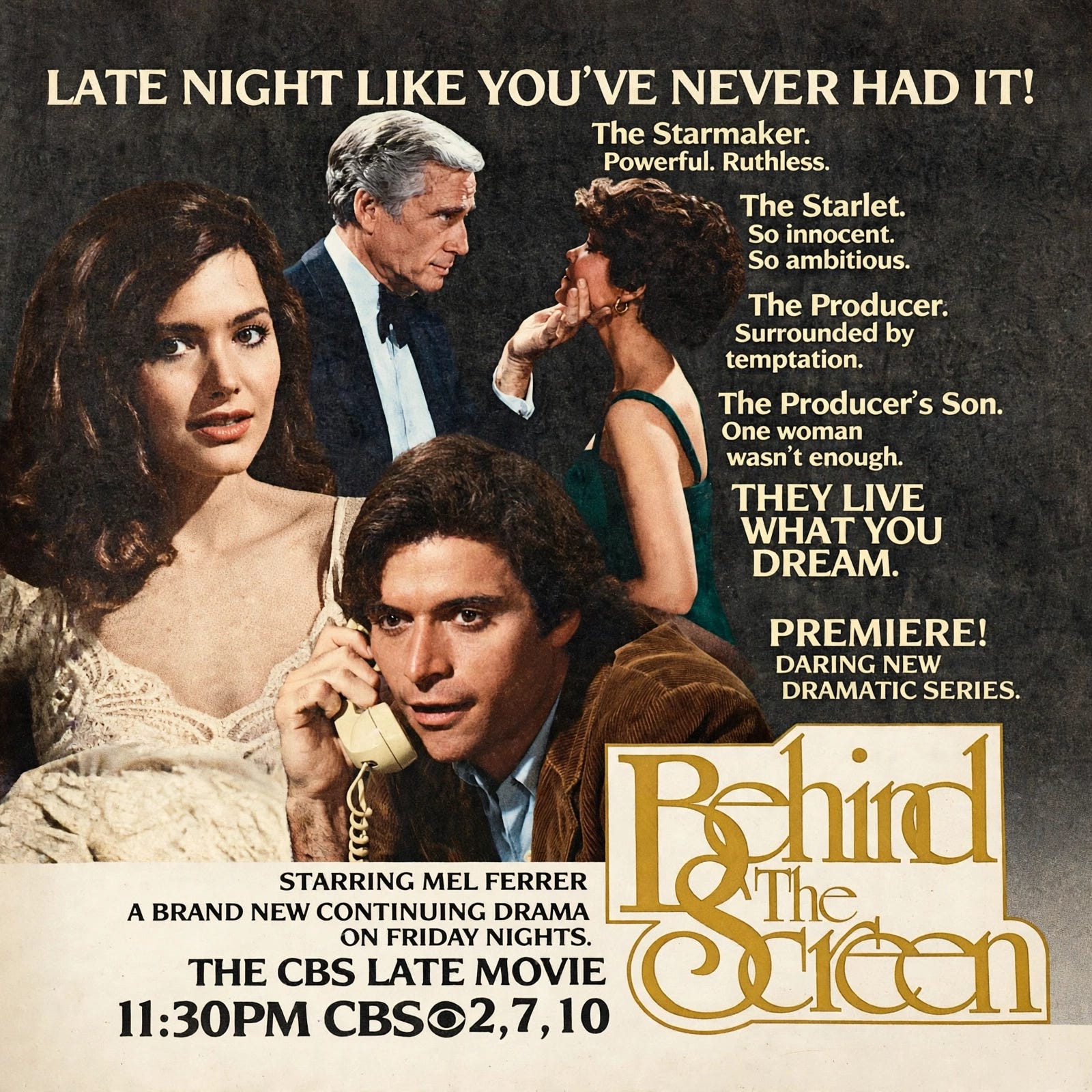
Following a one-hour premiere, the series settled into weekly 35-minute episodes. The first episode introduces Janine Claire Willow (Janine Turner), a glamorous soap star whose personal life is controlled by her manipulative cousin and manager (Mel Ferrer) and her disabled mother (Joanne Linville), while fellow actor Nick Landers (Michael Sabatino) resents working in daytime television.
The show began to take shape about a year-and-a-half ago when Bob Daly, then president of CBS Entertainment, asked Jacobs and Lee Rich, president of Lorimar Productions, to come up with a late-night strip show.
“We couldn’t agree on a budget,” said Jacobs. “Then Bob Daly left CBS and it seemed to die. I didn’t want to do it. I felt I’d done enough serialized drama. And this was out-and-out serialized drama. But it was on tape rather than film and I felt I ought to learn tape.”
“I didn’t study the soaps,” Jacobs said. “I didn’t want to have the long scenes or the pace of a soap.”
“Behind the Screen deals with Hollywood,” he said, “which has plenty of sex. But it still doesn’t need the sexiness that Dallas had in the first six months. I like sexy stuff but I think the emphasis will be on the story. It’ll be more provocative than titillating.”
Jacobs said he is going to have fun with the soap within the soap. “For one thing,” he said, “it is going to make absolutely no sense. No one will be able to figure out what’s going on.”
The original plan was to present the show three times a week, but they settled on one night each week (Fridays).
The series cast also included Joshua Bryant, Loyita Chapel, Bruce Fairbairn, Debbi Morgan, Lew Palter and Catherine Parks.
I was able to uncover only a handful of promotional spots while researching the series. Whether complete episodes still exist remains unclear.
A New Day in Eden
December 1982 - Summer 1983 (66 episodes)
Aired Fridays on Showtime at 11:30 PM ET/PT
If CBS experimented with late-night drama, Showtime was willing to push the envelope even further.
A New Day in Eden dramatized the business and romantic problems of the people of Eden, a city that had fallen into urban decay in 1970. That led to the arrival of the American Urban Renewal Investment Corporation (AURIC), a huge conglomerate which sank billions of dollars into Eden as a “test city,” hoping that if revitalization succeeded, the corporation could then sell their expertise to other decayed cities.
When viewers first arrive in Eden—12 years after AURIC’s takeover—they find a gleaming, prosperous metropolis watched over by the corporation, a presence creator Douglas Marland compared to Orwell’s “Big Brother.” Marland insisted the real story was about the lives of the people of Eden, who come from all walks of life: presidents of industry, business executives, college students and factory workers.
As the story opens Bryan Lewis (Jim McMullan), the president of Eden’s largest industry, Lewis Electronics, finds the stability of both his company and his city threatened when John Collier (Steve Carlson), a troubleshooter from AURIC, arrives to measure the progress of Eden and its people.
The power struggles and business machinations served as a backdrop for racier activities: an older woman-younger man romance, a deflowing in a barn, father-daughter incest, and a rash of rapes, murders, and mayhem on the local college campus.
Having just left his head writing job at Guiding Light, veteran soap scribe Marland was intrigued by the opportunity.
“I was fascinated by the fact that it was new - and it was cable. Network had been there and was well established long before I came along. This is the first time I have a chance to get in on the ground floor.”
The show thrived on the taboo, showcasing bodies and a combination of sex and violence, including a sexual assault in a shower, and one storyline featured a woman seducing her romantic rival.
Marland explained that Eden moved much faster than a daytime soap.
“People can talk like people really talk, especially the young people. They can call a spade a spade. You can use words like ‘screw’ and ‘ballbreaker’ and ‘shit’ if you want to, and there are times when you do. We had a chance to establish a style of shadows and dissolves which are much more erotic, because not seeing is still much more exciting.”
Despite its controversy and the fact that the cast included Steve Carlson, Jane Elliot (fresh from her run as Tracy on General Hospital & Carrie on Guiding Light), and Lara Parker (famous as the witch Angelique on the cult Dark Shadows) and that it was produced and sometimes directed by daytime veteran Susan Flannery, A New Day in Eden only lasted 66 episodes.
In our 2009 interview with Flannery, the Emmy-winning actress reflected on working as a producer on Eden.
My producing partners, Michael Jaffe and Gary Hoffman, did New Day in Eden. It was the first soap sold to cable. It was Oak Communications. They wanted us to continue with more seasons. My partner Michael said he didn’t want to do it . I said to him, ‘Are you nuts?’ But he didn’t want to do it so we didn’t do it.”
The show’s racier scenes made it too hot for network TV but perfect for Showtime.
That’s how they sold it. But there was never really any nudity. It was always delicately shot. You know who got his first job there? Jack Wagner.
Flannery would have preferred the show to have continued production. “It was a money maker,” she revealed.
Only a single episode has surfaced on YouTube. The fate of the remaining 65 episodes remains a mystery.
Rituals
September 10, 1984 - September 6, 1985 (260 episodes)
Aired in syndication at various day and night times around the country
Cable wasn’t the only place trying new ideas. Syndication also got into the soap business with one of the decade’s most ambitious launches.
Rituals was developed by Gene Palumbo, Clifford Campion, Joyce Corrington and John William Corrington for Lorimar, and was based on a novel by Charlene Keel. The show focused on power struggles between the wealthy Chapin and Gallagher families in the fictional college town of Wingfield, Virginia.
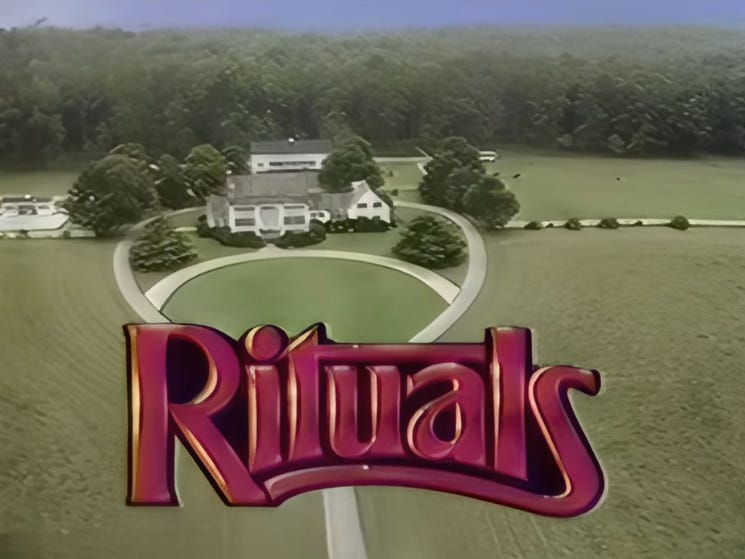
Lorimar hoped Rituals would become the first successful syndicated daily soap, giving stations an alternative to the network serials.
The drama began with the death of matriarch Katherine Chapin, triggering a battle for her vast estate.
The ensemble featured former James Bond star George Lazenby, General Hospital favorite Kin Shriner, future Days of our Lives actress Mary Beth Evans, current Beyond the Gates star Jon Lindstrom, and Philece Sampler.
Rituals was a high-stakes venture, as one of the first made-for-syndication soap operas. At the time, many industry observers believed Rituals could open the door for a new generation of syndicated daily dramas.
Despite its star-studded cast and lavish production, it was cancelled in July 1985 following the May sweeps. The final episode was taped on July 1, 1985, and aired that September. The show aired in France and Brazil through 1990.
Some archival footage and promotional clips are available online but few complete episodes. Unless a forgotten tape collection surfaces, the series remains inaccessible to modern audiences.
Loving Friends and Perfect Couples
January 4, 1983 - November 8, 1983 (80 episodes)
Originally aired late nights on Canadian pay network First Choice then multiple weeknights at 11:00 PM on Showtime
Created by David Jacobs, Loving Friends and Perfect Couples was billed as an “adult” soap opera, including unedited nudity, profanity and simulated sex, and was ultimately a parody of soap operas similar to Mary Hartman, Mary Hartman. In the United States, the series aired simultaneously on subscription television service ONTV and pay cable network Showtime until December 1983, after which U.S. broadcasts ceased.
Produced by Global Television for Lorimar Productions and Showtime, the series consisted of 80 half-hour episodes exploring intimate relationships, role-playing, and erotic themes among a group of friends and couples. Originally broadcast on the Canadian pay TV service First Choice, it was one of the earliest soap operas to incorporate explicit content, making it one of the boldest soap experiments of the decade.
Loving Friends and Perfect Couples centers on David, an unemployed architect struggling with financial difficulties and emotional turmoil as he attempts to establish a ménage à trois involving his wife and another woman in their shared living arrangement. This central plot explores the tensions arising from job loss, unconventional relationship dynamics, and the strains of group living among friends and couples.
The show included storylines about open marriages, threesomes, and personal fantasies in a contemporary urban setting.
The ensemble included Mimi Kuzyk as David’s ex-wife, Lisa Howard as Melissa, Lori Hallier as Ann, veteran soap actor Tom Hallick as Jasper, plus Ross Petty and future soap stars Cali Timmons and Jack Wagner.
To justify his investment in soaps at the time, Greg Nathanson, Senior Vice President for Showtime Entertainment - the major distributor of cable soaps - pointed out the popularity of the serial format in both television and publishing, where the success of the romantic novel had reached unprecedented proportions. “The time is right for an adult serial on pay television,” he said.
Jacobs found it easier to be real on cable.
“In cable you can create characters who change in a realistic and interesting way. On network television, this is not always possible. In Loving Friends our characters don’t pull the sheets up to their chins. When two people are making love in bed, let the sheet fall where it may.”
Today, the series remains largely unavailable through official channels, with no releases on home video, DVD, or major streaming platforms. Complete archives or episode guides are incomplete, limiting access to scattered fan-preserved materials online.
Lone Star Bar and Grill
June 15, 1983 - November 8, 1983 (at least 12 episodes, total number unconfirmed)
Aired on Showtime, Thursdays at 9 PM then Fridays at 6 PM
Created by veteran daytime soap writer Pat Falken-Smith and her producing partner Brad Radnitz, The Lone Star Bar and Grill was not a traditional soap opera. Contemporary reviewers described it as a “country-western soap opera musical series.” The show was shot on location in Houston.
Falken-Smith said what they were going for was a new genre.
“It’s a departure. It has core characters in the bar - the owners and the people who work there - but each episode is feature film length. Each one has an ending for that particular episode but ongoing characters. Each segment is resolved, yet there are unresolved elements in it. So in that sense, I suppose it would be more like Dynasty.”
In the first episode a jealous husband fantasizes what his wife is doing in a hot tub with his best friend. Falken-Smith says the scenes are in good taste.
“In reality, we intercut his fantasy with the fact that he and his wife are, actually sitting in a hot tub and she’s crying about how their marriage isn’t working out. So we’re getting the sexuality without it being reality and we’re doing it in a ballet sequence, like they did in The Blue Lagoon. It will be beautiful to look at; it won’t be overt sex.”
The Lone Star Bar and Grill is owned by Buddy Tyler (Mayf Nutter), returning home after a 6-month recuperation from a car accident. Following his accident, Buddy uses a wheelchair, is impotent, and—perhaps most devastating to him—believes he has lost the ability to sing. By the second episode, Buddy had turned to a mistress for comfort.
In addition to Nutter, the cast featured a mix of actors and musical performers, including Penny Bennett as Alma, Lindsay Bloom as Pam, Kevin Cooney as Mark, Blue Deckert as Dave, Maggie Egan as Sally, Galen Everhart as Mary Beth, Nik Hagler as Buck, Bonnie Isaac as Mattie, Dianna K. Hill as Candy, Cliff Osmond as Cal, Kent Perkins as Clete, Jeannine Riley as Arlene, Chuck Winters as Duke.
Several contemporary reports suggested The Lone Star Bar and Grill performed well for Showtime before a change in network leadership ended the experiment after one season.
There’s one promo on YouTube for the series, and a partial premiere episode at the Internet Archive. Today, the series exists largely as a curiosity, with only promotional material and scattered clips surviving online.
Why Aren’t These Soaps Available Today?
Despite loyal fan followings, many series from the 1980s remain unavailable to stream or purchase. The obstacle is rarely a lack of interest. Instead, it is a tangle of legal and financial hurdles: unclear rights after decades of corporate mergers, expensive music and talent clearances, and licensing agreements that must be renegotiated for modern distribution. In other cases, master tapes have been lost or damaged, making restoration difficult—or impossible.
Ultimately, it comes down to economics. Studios must weigh the cost of clearing rights and preparing a series for release against its potential audience. For niche titles, including many soap operas, the numbers often do not justify the expense.
Whether lost because of tangled rights issues, missing master tapes, or simple economics, these series represent a fascinating and overlooked chapter of television history. They remind us that the soap opera genre was far more adventurous than many viewers realize, extending well beyond traditional daytime television into cable, syndication, and late-night programming. Perhaps one day these forgotten serials will be restored, rediscovered, and appreciated by a new generation of fans.
Roger Newcomb is a New York–based producer, writer, and media entrepreneur. He is the founder and executive producer of the Indie Series Awards and publisher of We Love Soaps. He’s also executive producer/host of interview series We Love Soaps TV and history show Soap Opera Time Capsule.
Related Articles:

"Another Life", which debuted on The Christian Broadcasting Network in 1981, was the first soap on cable, not :A New Day in Eden"
ReplyDeleteSurely, A New Day in Eden would be even more popular today in our current moment.
ReplyDelete