.png)
By Michael Poirier
Contributing Writer, We Love Soaps Insider
Gloria Monty gets credit for taking General Hospital’s anemic viewing numbers and creating a phenomenon where the soap was often number one in the Nielsen ratings for much of her tenure. However, there was another period when the hospital drama was often near the top of the ratings, bouncing between number one and number five from 1970 to 1973, with show creators Frank and Doris Hursley still guiding the fates of the characters. They remained in charge until they decided to retire to Montecito after Doris became ill. Their daughter Bridget and her husband, Jerome, who were already members of the writing team, then took over as head writers.
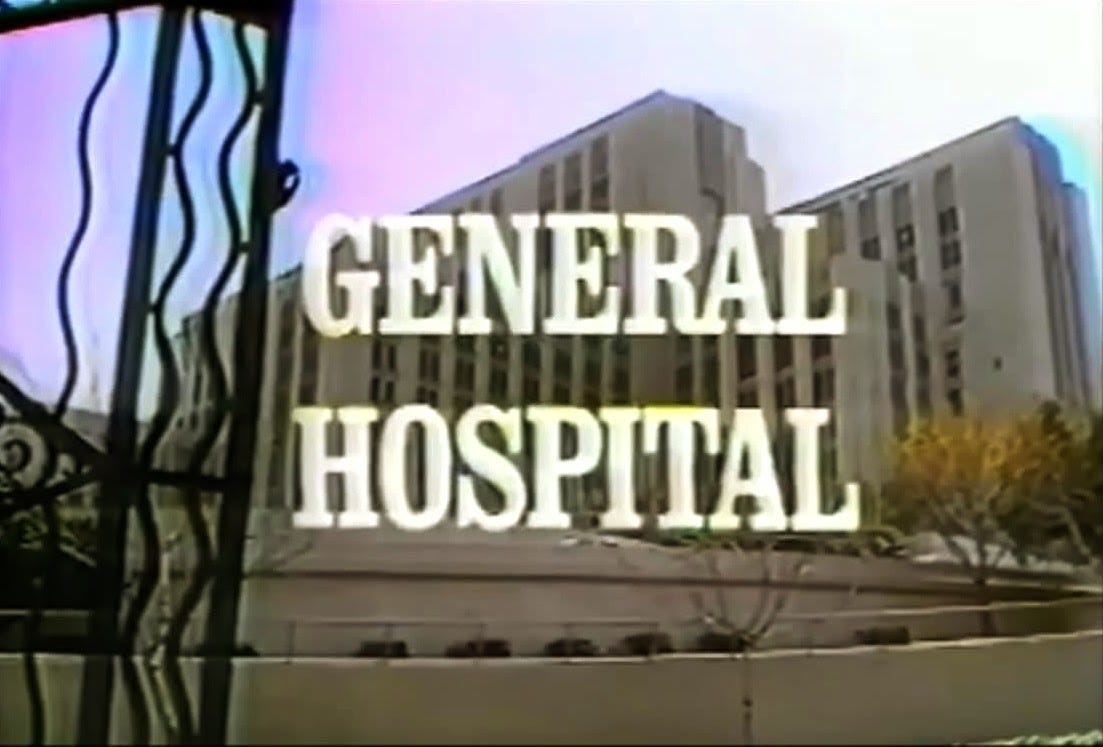
The Dobson Era
By spring 1974, the ratings began to sink and continued to fall. Viewers were not interested in the months-long plot about Mai-Lin, a Chinese ballet dancer who was hoping to defect and whose father had once been childhood friends with Steve. The Dobsons decided to see if Martin West was available to return short-term as Phil Brewer, the ex-husband of much-put-upon heroine Nurse Jessie Brewer. He signed for two months, with another six weeks of extensions. The murder of the villainous Brewer in December 1974 did not give the show the boost it needed. Even with the reveal of the killer, Augusta McLeod (Judith McConnell), in April 1975, the show still could not crack the top five. Shortly afterward, head writers Bridget and Jerome Dobson left to helm The Guiding Light.
The hospital drama saw multiple cast and crew purges over the next few years. Longtime producer Jim Young left in early 1975 and was replaced by Tom Donovan. Subsequent writing teams were headed by Richard and Suzanne Holland, Robert and Eileen Mason Pollock, Irving and Tex Elman, and the Hollands again. The show expanded from 30 minutes to 45 minutes in July 1976. What was it like behind the scenes during these years?
General Hospital in Transition
Marla Pennington came aboard in 1975, replacing Kimberly Beck in the role of Samantha. I asked her about some of her favorite memories.
“It was only a half an hour show and we shot during the day and in the afternoon. Then you would rehearse if you worked the next day. And if you had like four days in a row, which they tried not to do, because people would get sick! You would be there all day and just learning tons of lines.”
“The other thing I remember so well—working with John Beradino. They had these, I called them the ‘monkeys’… they were the teleprompters, and there were these guys with your lines on it, and they would be trying to meet your eye line so that if you forgot your line, you could just go right into it. I just made it a big thing that I didn't want to do, and I never did. I was very proud of that. I had a scene with John Beradino, total pro, and he did not learn his lines. He was practiced and so good at just finding a space and seeing his teleprompter there and just reading off of it, but in a very natural way.”
“The first half the time I was there, I smiled all the time because they really liked my smile. And then they learned I could cry on cue. And then I cried so many times. I had the same line after my husband, Bobby Chandler, had a horrible blood disease and he was going to die. I was his new bride and he didn't want me to know. The line, ‘I feel like a wounded animal that no one will put out of this misery,’ I said it so many times and always with a tear coming down. It was hysterical.”
The writers during this period were Richard and Suzanne Holland of New York. The couple, who had written for many other soaps, including Young Doctor Malone, The Nurses, A World Apart, and All My Children, claimed they worked 15 to 18 hours a day, seven days a week. Their subwriters included Frank Salisbury, Jane Lyon, and Fielden Farrington.
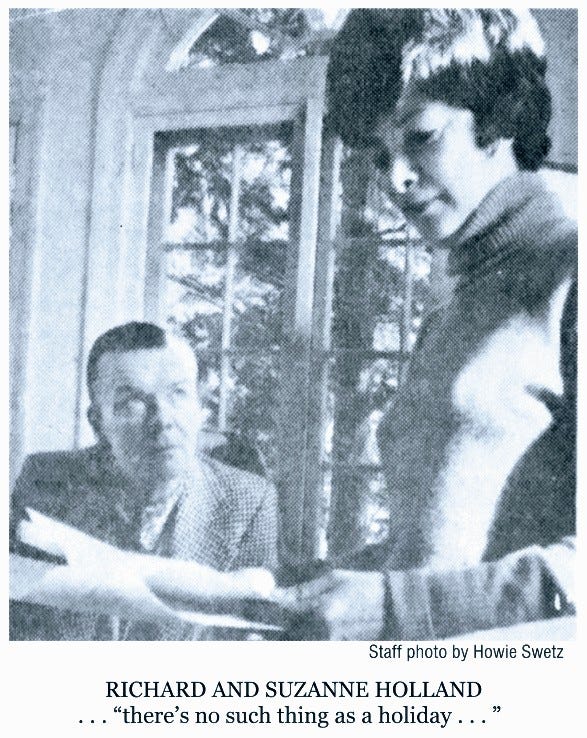
Speaking with local reporter Elaine Bissell, the Hollands explained how they worked.
“We give the writers who work for us an outline, with a breakdown by acts and scenes,” Suzanne said. “They have to know the style, of course, and they must watch the show every day, so that they'll know all of the characters thoroughly.”
“We talk long-term plots to them,” Richard said, “and they get copies of all the outlines. Then on the phone they get the corrections and additions, and a copy of every raw script as it goes off to the West Coast, then a script as it comes out of mimeo.”
“It's not only fascinating,” said Suzanne. “It's terribly rewarding as well. It's such a good way to get moral issues across, and it's a way of helping people. We get into all kinds of things, drugs and child abuse just as an example.”
“And there's been something of a revolution,” said Richard. “Today, in the soaps, you can attack problems on daytime drama that you can't even approach at night. And not only that, there's a writing quality and superior acting quality that you can't get in a film.”
“So few can do this kind of writing,” Richard believed. “Most young people just don't have this kind of discipline. We have a development program, trying to find writers, but every one under the age of 50 struck out.”
“There are only 16 head writers of soap opera in the whole world of television,” said Suzanne. “For just 14 shows. And in this business, there's just no such thing as becoming ill.”
Although the ratings were respectable during their tenure, they had slipped from when the Dobsons were in charge. General Hospital was often ranked number eight or nine out of 14 soaps. Shortly after the new year, the Hollands were replaced by Robert and Eileen Mason Pollock, the former head writers of The Doctors.
The Pollocks Shake Up Port Charles
Their first order of business was to get rid of several characters. Bobby and Samantha Chandler, Caroline and Lee Baldwin, Kyle Bradley, Kate Marshall, Jim Hobart—even the longtime character Lucille March—were exiting the canvas.
The Webber family was created, but they didn’t move to Port Charles. The Pollocks finally gave the city where the characters resided a name, although they didn’t identify which state. Allegedly, it was in Ohio. The writers simply pretended the characters had lived there all along.
Bobbi Jordan joined as Terri Webber, Richard Dean Anderson as Jeff, Michael Gregory as Rick, and Patsy Rahn as Monica.
The fans did not take to all the changes, and the ratings fell as far as 5.4. Producer Tom Donovan spent an estimated $80,000 on new sets to give the show a new look. The show no longer bought costumes off the rack, and a Beverly Hills boutique became the new supplier. Even the hair department was revamped, and actors were given more current styles.
On July 26, 1976, both General Hospital and One Life to Live were expanded to unwieldy 45-minute shows. The expansion meant the addition of new cast and crew, such as John Zak, who joined the production as a lighting director.
“My career at ABC, literally, started because General Hospital was moving from half an hour to 45 minutes and they needed an additional Lighting Director for the series. I began during the half-hour production format when the show was produced ‘live on tape.’ It was quite a fast-paced operation, with dry rehearsal in the morning, a couple of rehearsals later in the day, and taping in the early afternoon.”
“Rehearsal for the next day took place in the late afternoon. I was amazed at how efficiently and how quickly the production ran. But soaps did not yet have the level of production available to them due to small budgets and, perhaps, ambivalence about the future of the medium. We literally had to finish our taping by approximately 4:30 in the afternoon, at the latest, because our videotape machines had to be used for the 5 p.m. local news broadcasts.”
Soap Opera in Crisis
Even more new characters were added, such as Mark and Mellie Dante. Adding to the chaos at the ABC studio, James York played Mark for a week. Mike DeLano lasted just a few days. Finally, daytime favorite Gerald Gordon, who played Nick on The Doctors, was cast. Former One Life to Live actress Lee Warrick played Mellie.
Heather Grant was another new creation and was played by singer Cher’s sister, Georganne LaPiere. Sensing that viewers wanted some discarded fan favorites back, Peter Hansen was rehired as Lee Baldwin a few months later.
The head-writing team spoke to journalist Isabel Silden, who worked with Jon-Michael Reed, about their methods.
“The average viewer who writes that they don't like the changes are in such a groove. But they often end up liking the changes. They get out of their viewing rut.”
Defending their massive cast cuts to the press, who noted that only six characters were left who had been there the previous year, the Pollocks claimed it was a matter of “evaluations of strength.”
“Also, the story takes off just as in real life and goes in another direction. You may plan to do something on Monday, but on Tuesday something else happens. By Wednesday you have changed your plans entirely. We start with a basic idea, working on a six-month projection, but then the actor delivers something extra.”
“Mark Dante, for example. We didn't foresee it, but now that character is a part of the broad, overall canvas. It is sometimes sort of Godlike, but even we don't know what will happen. It's fascinating the way characters take over.”
Despite the viewer erosion, the Pollocks remained pleased with their creations.
“We are delighted with our new people. I think Michael Gregory (Rick Webber) is a very bright star and Bobbi Jordan (Terri Arnett) is really quite good. Some of her performances are as good as anything you will ever see on any series,” claimed Eileen.
The couple felt that they and producer Tom Donovan were putting out a “damn attractive show.”
“The new music makes it very up-to-date. The viewers will see less of an over-the-teacups show and more action. It will pay off in ratings in the not-too-far distance.”
Eileen ended the interview with the following:
“It's against my religion to divulge storyline. To find out, you'll have to tune in tomorrow.”
Early December was a tough month, and the 13-year-old show was now second from the bottom, just above the dying Somerset. However, there was a miraculous rebound, and by January 1977, the ratings rapidly began going back up. Daytime columnist Lynda Hirsch declared that the show was off life support. Her assessment was premature, and the soap dived in the Nielsen ratings again.
Hoping to lure more NBC fans over to the show, Anna Stuart, another alum from The Doctors, joined the soap as Gina Dante.
The most important casting decision, which would help save the show later, was hiring Genie Francis to take over the role of Laura Vining. I asked her what the show was like prior to Gloria Monty becoming executive producer.
“The production before Gloria came aboard was very antiquated soap in that it was two people sitting at a kitchen table talking. They didn't even have three walls on the sets. It was literally like a book, like two flats, and we'd have to sit right inside the fold there. And literally everything was shot like that. Cameras were locked off. They didn't move around and see anything.”
During this period, and to the delight of fans, tortured lovers Dr. Steve Hardy and nurse Audrey Baldwin were wed. Little did they know that her allegedly deceased husband, Tom Baldwin, was making his way back to Port Charles.
By the summer of 1977, ABC, led by Fred Silverman, had had enough and fired the Pollocks. Scriptwriter Frank Salisbury recalled how suddenly it happened.
“We even visited the Pollocks in Palm Springs and came away feeling like a strong team. But not long after, they were let go rather abruptly.”
Original cast member John Beradino looked back on this time of turmoil.
“Our writing fell off. The audience began to lose interest. All of us became so frustrated that we petitioned the network to fire the writers. We won, but the next writers weren't much help, either.”
Irving and Tex Elman replaced the Pollocks with much hoopla. Immediately, popular actors such as Don Chastain, Bobbi Jordan, Patsy Rahn, Lee Warrick, and Valerie Starrett were dismissed.
Leslie Charleson took over the role of Monica. Starrett was upset about the direction of her character. She and the show’s producer, Tom Donovan, had repeated fights, some of which focused on her frequent rewriting of the dialogue, which led to her removal. She was not even told in person, but by phone. She was replaced by Brooke Bundy.
Lee Warrick’s Mellie was slated to be killed off. Bobbi Jordan laconically noted that her fans would be disappointed by her departure.
“I keep getting letters from viewers asking when Mark and Terri are going to be married. Boy, are they going to be surprised when they find that Terri's off the show.”
Joining the show during this tumultuous period was Kin Shriner as a recast Scotty Baldwin. He told me what it was like.
“When I started on General Hospital, Tom Donovan was the producer and we were live at 2 o'clock to 2:45 on tape. The show was done.”
Hoping a natural disaster would shake up the show, a hurricane hit Port Charles. Much like the storm, the Elmans were shown the door at the end of September 1977. They lasted less than two months in the job.
Meanwhile, the network was concerned with the look of the show, including the lighting. John Zak reminisced about a meeting concerning possible fixes.
“I was trained by a lighting Director named Ronn Holden. He was sort of a crusty old-timer, but a very talented lighting Director. When the show was under network scrutiny, ABC sent a big-time lighting consultant to observe our production and look at tapes. We met at the ABC commissary. We didn’t touch our food. The consultant said, ‘There is nothing wrong with the lighting of this show and I will tell management.’ We were stunned. I thought that this man must be quite talented and fair-minded to tell things as he saw them.”
Searching for a Way Forward
The Hollands were brought back to try to salvage the show. By fall 1977, the ratings began rising again, and the show got as high as number six in the ratings.
Network executive Jackie Smith felt the show needed something more and hired former The Doctors head writer Doug Marland to watch the show. As he told Robert LaGuardia:
“I was paid to watch the show for about two months. I read all the breakdowns—hours and hours and weeks of reading, boxes of outlines all out of continuity. They were taken from ten different writers' story submissions. The show was so boring that I couldn't sit in the room and watch it for forty-five minutes, which made me feel guilty because I was being paid rather handsomely. I'd fidget, get up, leave the room, come back.”
“On the show they had people sitting on opposite sides of a desk, just talking for an entire scene; two people in a cafeteria sitting and talking; two people in a kitchen. No movement, just talk, and there wasn't much to talk about, because there wasn't much happening.”
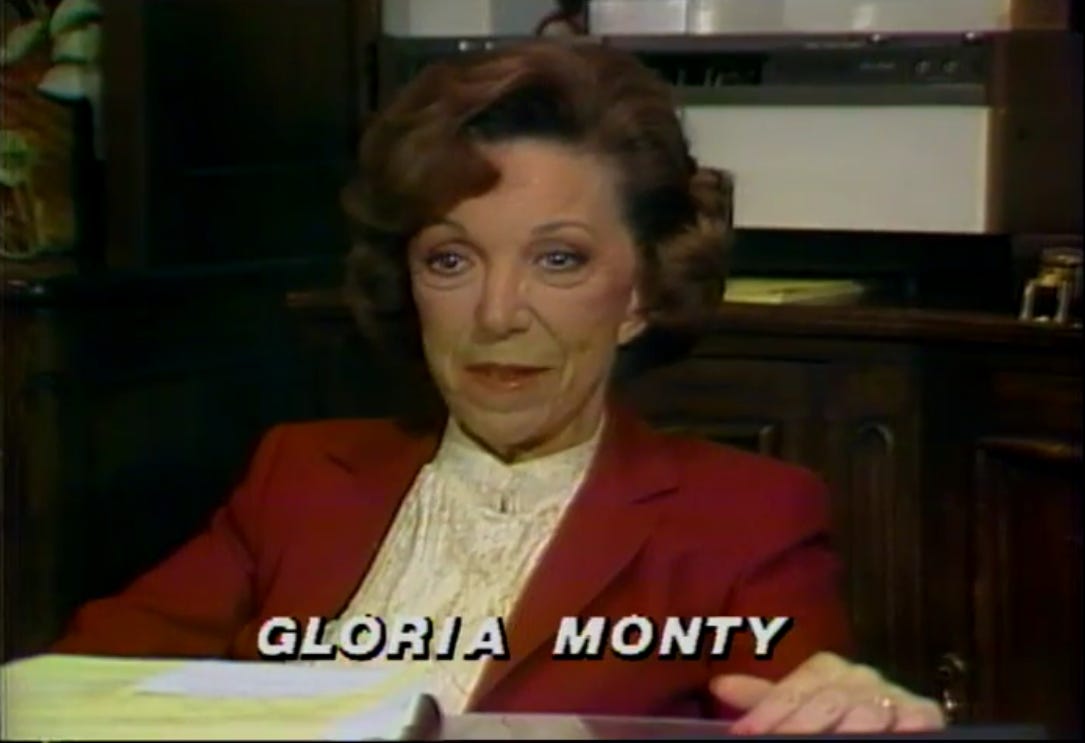
Just after Marland was hired to consult, Jackie Smith asked Gloria Monty to take over as executive producer. Like Marland, Monty was asked to view a few weeks of episodes.
“The lighting was so bad, I thought, ‘My God, what ugly-looking people. They should all get in an airplane and crash.’”
Smith told Monty that Fred Silverman was giving her six months to get the ratings up or the show would be canceled. One of her mottos when starting the job was, “Character is all.”
Veteran soap creator Agnes Nixon looked over Marland’s notes and bluntly told ABC executives to hire him as the new head writer.
Enter Gloria Monty
Rumors of more change filtered down to the cast and crew, according to John Zak.
“We had heard about the possibility of Gloria Monty coming in to produce the series, but we did not know when. I was able to observe Tom Donovan’s distress late one night when I was finishing lighting a set for the next day. As the crew retired for the evening, Tom came to the stage and sat down. We spoke for a while on the semi-darkened stage, and he shared some of his disappointment and frustration about the state of the show.”
“Tom Donovan was a distinguished producer and director of the old school, having spent much of his career in New York City. In many ways, his hands were tied by budgetary constraints and, as noted by others, the show was produced in what was, even in those days, an antiquated fashion.”
“There was no time for retakes, even when occasional mishaps took place on stage. There was an ability, albeit a primitive one, an ‘edit tech,’ which basically was a punch-in edit on the fly. This would be used only if there was a problem that simply could not be allowed to go on the air. It was a tricky bit of technology, and sometimes the edit did not take, so it would be necessary to tape the scene yet one more time to get it.”
“What I perceived as a new member of the team is that, even with its limitations, General Hospital was an elegant show.”
Just before flying out to California, Gloria Monty arranged to get together with her new partner in this venture.
“Before I came out here I had a long meeting with Doug Marland, the show's head writer, who hasn't been with the show very long himself, and we both agreed that the stories have to evolve from the characters. Also, since it is an hour long, we wanted it to be faster-paced with a better look and a definite distinguishable quality.”
What was it like meeting Gloria? John Zak perfectly describes the energy of this day of change and renewal.
“Tempo. I will never forget the day of Gloria Monty’s arrival. We were in 7 a.m. rehearsal with cast on stage. I was standing near the stage door when Jackie Smith arrived with a petite woman whom she introduced as Gloria Monty. So that’s Gloria Monty!”
“Jackie asked me to gather my crew at the Nurses’ Station because she had an announcement to make. Jackie walked toward the area where we had been rehearsing and asked for everyone’s attention. She said, ‘We have viewed the first four episodes of the one-hour show and they are unacceptable for broadcast. Please take out your pencils. This is Gloria Monty. She will be taking over the show. Today’s episode will be the first one-hour episode that will air. We are throwing out the previous episodes.’”
“Tom Donovan departed the scene, never again to be seen on that show.”
The Renewal of General Hospital
As another curveball, Silverman expanded the show to one-hour-a-day episodes. Beradino harkened back to the first day of Gloria Monty’s new production model.
“For our first one-hour show we worked from 7 in the morning until midnight,” Beradino said. “Then it was 7 to 10:30, and now we usually get done by about 8:30. Sometimes you're pretty groggy by the time they get around to shooting. Visine in the eyes and all that. You have to really reach back for something extra.”
Genie Francis, when reflecting back on this time, told me:
“When Gloria came on, we had been a 45-minute show and we just went to an hour, and I think we did two (sic, four episodes) weeks of our episodes. Gloria came on, she threw them all out because she wanted the show to feel like a brand-new show when it went to an hour. And we worked hard, but we all felt like we were in the middle of something very special. It was an exciting time. She was a real storyteller, you know.”
Kin Shriner remembered it similarly when I asked him about it.
“When Gloria Monty took the show over, she changed the format and started editing stuff and changing the scenes and making it more like a movie. They went really young with Genie and me to try and hopefully get younger viewers. So, that was that.”
Long workdays became the norm to achieve the goal of turning the show around and maintaining a standard of excellence. John Zak, like the rest of the cast and crew, was excited about the challenge.
“John Beradino, in particular, really rose to the occasion and, as the senior male lead on the show, he set the tone for the actors. He knew something was needed and seemed to believe that Gloria might be the savior who would turn the show around.”
“We finished taping at around 11 o'clock at night. Long production days became the norm for many years. The results were palpable. Scenes had an energy that had been missing, and ‘coffee-talk’ scenes disappeared from the scripts. In fact, Gloria insisted on ending scenes with movement, rather than with faces staring at each other lugubriously. That was radically new.”
“There was a combined sense of shock and relief among the cast, many of whom had been on the series for a long time and felt that the ratings and storylines had been going in the wrong direction.”
The ratings held steady at first. Then every single show took a hit in viewers. However, the vulnerable soap opera began to climb again. The first week in June, it was back at number four in the Nielsen ratings. The first week in August, it hit the number two spot.
The show finally had a winning formula for gaining viewers. Much has been written about the show’s miraculous turnaround, but hopefully readers will learn something new about this often-neglected period in the show’s history.
John Zak sums up that moment in time:
“When I look back, I think that the pre-Gloria years of General Hospital have been judged a bit too harshly. I remember some very moving, beautiful performances from cast members like Denise Alexander, Rachel Ames, Bobbie Jordan, and others. The show, in my view, was fertile ground. It just needed watering, pruning, and a lot of love.”
Thank you to John Zak, Genie Francis, Kin Shriner, Marla Pennington, the late Frank Salisbury, Mitch Sandusky, Floyd Elwell, Francisco Lopez Camara, and Mark Faulkner.
Native New Englander Mike Poirier has written for numerous maritime journals and national newspapers. His research and memorabilia collection can be seen in many liner books and TV specials, including Erik Larson’s best seller, “Dead Wake”. He also co-authored, “Into the Danger Zone” with Tad Fitch.


0 Comments